<link rel="stylesheet" href="https://cdn.jsdelivr.net/npm/instantsearch.css@8.0.0/themes/satellite-min.css"/>

Laser hair removal has come a long way from its early reputation. What once felt experimental is now a well-established, medically supported treatment used by millions of people every year. Understanding the hair removal evolution helps explain why modern laser hair removal is as reliable and effective as it is today.

Early Hair Removal Methods Before Lasers

Long before laser technology existed, people relied on shaving, waxing, threading, depilatory creams, and electrolysis for body hair removal. Each method had its place, but none came without drawbacks.

Shaving and waxing delivered quick results that didn't last. Ingrown hairs, irritation, and the need for constant upkeep were part of the deal. Threading offered precision but was time-consuming and limited in scope.

Electrolysis was the closest thing to a long-term solution available at the time. By targeting individual hair follicles with an electric current, it could produce lasting results. But treating large areas requires significant treatment times and commitment. The introduction of laser beams as a treatment tool would eventually change the equation entirely.

The First Laser Technologies In The 1990s

Laser hair removal emerged as a commercial treatment in the mid-1990s, opening the door to a new approach to long-term hair reduction. Early devices were a significant step forward, but they came with real limitations.

The technology of the time was primarily designed for lighter skin tones where skin pigment and hair color created the highest contrast combination available. Those with different skin types had fewer options and a higher risk of skin damage during treatment.

Early treatments were also less customizable than what's available today. Settings couldn't be fine-tuned to the same degree, which made the experience less comfortable and the outcomes less consistent. It was a promising start, but the technology still had a long way to go.

Advancements In Laser Technology

The decades following those early devices brought meaningful progress. The development of the Alexandrite laser and Nd:YAG laser gave providers better tools for targeting hair follicles more precisely while minimizing impact on the surrounding skin. Longer wavelengths, in particular, opened the door to safer treatment for a wider range of skin tones. This progress was rooted in the principle of selective photothermolysis, the science of targeting specific tissue with precise wavelengths of light without affecting the surrounding skin.

Cooling systems were another game-changer. Built-in cooling technology made treatments more comfortable and helped protect the skin during the process, a significant improvement over earlier devices. At Milan Laser, every laser pulse is delivered with an air-cooling Chiller to maintain Client comfort.

While intense pulsed light devices (IPL) emerged as an alternative during this period, those at-home devices lack the precision of true laser technology, making them a less targeted option for consistent, long-term results.

Energy delivery also became far more precise. Modern systems allow providers to customize settings based on the Fitzpatrick Skin Type Scale, and treatment area, making each session more targeted and effective than what was possible in the early days of the technology.

Modern Laser Hair Removal Today

Today's laser hair removal looks very different from where it started. Safer protocols and medical oversight have made treatment more reliable and consistent across a much broader range of patients than early technology allowed.

Outcomes are more predictable, too. A modern laser system, combined with providers who understand how to customize treatment, produce results that earlier systems simply couldn't deliver with the same level of confidence.

Research and refinement continue to push the technology forward. New devices and improved techniques mean the standard of care today is better than it was even a few years ago, and the field continues to evolve.

What hasn't changed is the fundamental expectation: laser hair removal provides permanent hair reduction for most people. It's not permanent hair removal for every follicle, but for the vast majority of patients, the results speak for themselves.

What Has Not Changed

For all the progress the technology has made, some fundamentals remain the same. Hair color still plays a critical role in how well laser hair removal works. White and gray hair lack the pigment the laser needs to target effectively, and no advancement in technology has changed that.

Multiple sessions are still required. Hair growth occurs in cycles, and laser treatments can only target follicles in their active growth phase. That hasn't changed, and it's why completing a full treatment series is just as important today as it ever was.

Hormonal influences are another constant. Changes from pregnancy, menopause, or certain medical conditions can stimulate new growth over time, particularly in hormone-sensitive areas. Modern technology manages this better than ever, but it doesn't eliminate it entirely.

Quote mark

Longer wavelengths, in particular, opened the door to safer laser hair removal treatment for a wider range of skin tones.”

Why Milan Laser Is The Best Option

The history of laser hair removal shows one clear trend: better technology and better oversight lead to better outcomes. Milan uses modern laser technology designed to treat a wide range of skin tones with precision and safety in mind. Treatments are performed under medical oversight by trained providers who customize settings based on your skin tone, hair thickness, and treatment area. This level of personalization reflects how far laser technology has come from its early, one setting approaches.

With more than 400 clinics in 38 states, Milan Laser is the country’s largest provider of laser hair removal. We also offer something nobody else in the industry does: our exclusive Unlimited Package™. You pay one price for a body area, and you’re covered for life. No hidden costs or touch-up fees. Choosing Milan for your hair-free needs will help you say goodbye to unwanted hair for good.
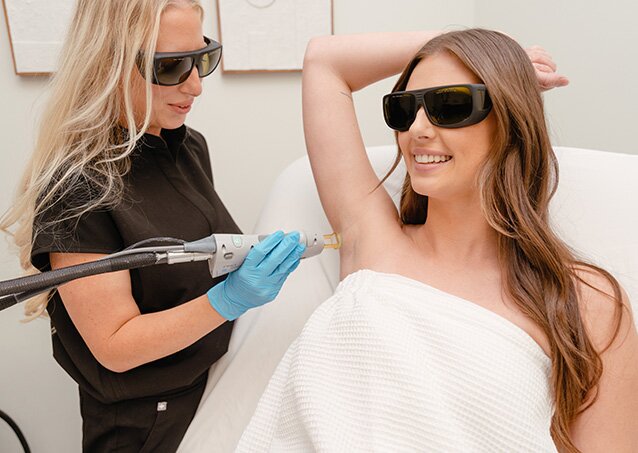

A woman wearing protective eyewear in a treatment room at Milan Laser gets laser hair removal on her underarms for a blog titled History Of Laser Hair Removal.

Start Your Journey Today

Discover the game-changing benefits of laser hair removal for yourself with a free consultation. This conversation is an opportunity to discuss goals, concerns, and expectations to determine a personalized treatment plan. Visit MilanLaser.com or any of our clinics across the country and join the hair-free movement today!

Milan Laser consultation session

Frequently Asked Questions

Laser hair removal was developed in the 1960s and 1970s as researchers explored the effects of laser light on hair follicles. It became available as a commercial treatment in the mid-1990s, when the first devices received FDA clearance for hair removal.

Early laser hair removal was a legitimate medical treatment, but the technology had real limitations. Devices were primarily designed for lighter skin tones, and the ability to customize settings was more limited than what's available today. Modern advancements have made treatment significantly safer and more inclusive across a wider range of skin tones.

Modern laser technology offers improved wavelengths, built-in cooling systems, and far more precise energy delivery than early devices. These advancements have made treatment more comfortable, more consistent, and safer for a wider range of skin tones and hair types than was possible in the early days of the technology.

Yes, modern laser hair removal benefits from significantly improved technology, safer protocols, and medical oversight that earlier systems didn't have. Customizable settings and better wavelength options have made treatment more precise and more inclusive than what was available when the technology first emerged.

Modern laser technology at the right clinic has made treatment safer and effective for all skin tones than early devices allowed. The right wavelength is key, which is why working with a knowledgeable provider who uses appropriate technology matters.

Laser hair removal works by targeting pigment in the hair follicle. Dark hair contains the most pigment, giving the laser a clear target and producing the best results. White and gray hair lack the pigment needed for the laser to work effectively, which is why hair color remains one of the most important factors in determining candidacy.

Book Your Free Consult

Select a location from the list

Find Milan Near You?
OR