

With more than 400 clinics in 38 states, Milan Laser is the country’s largest provider of laser hair removal. We also offer something nobody else in the industry does: our exclusive Unlimited Package™. You pay one price for a body area, and you’re covered for life. No hidden costs or touch-up fees. Choosing Milan for your hair-free needs will help you say goodbye to unwanted hair for good.

The laser type used in your treatment matters, not just for results, but for safety. Here's a plain-language breakdown of how each works, which skin tones they suit, and why Milan uses a dual-wavelength system that covers all of them.
Why Laser Type Matters More Than Most People Realize
Laser hair removal works by targeting melanin in the hair follicle, but the wavelength of the laser determines how that energy interacts with both the follicle and the surrounding skin. Different wavelengths are absorbed differently by melanin, which means the wrong laser for a given skin tone isn't just less effective, it can be unsafe.
For Clients with lighter skin tones, a wide range of laser types can work safely and effectively. For Clients with medium to dark skin tones, the wavelength selection becomes a direct safety consideration. Understanding the differences helps explain why not all laser hair removal is equal, and why the device your provider uses matters as much as their technique.
Alexandrite Laser
The Alexandrite laser operates at 755nm, introduced here as the shorter end of the professional laser hair removal spectrum. At this wavelength, the laser is highly absorbed by melanin, making it precise and effective at targeting hair follicles in Clients where there is strong contrast between dark hair and light skin.
The Alexandrite is well-suited for Fitzpatrick Skin Types I through III, very fair to light skin tones. It performs effectively on coarse and medium-thickness dark hair, and its wavelength characteristics make it a strong option for larger treatment areas on appropriate skin tones.
The critical limitation is skin tone. The Alexandrite's wavelength is readily absorbed not just by follicle melanin but by surface skin melanin as well. In Clients with Fitzpatrick Skin Types IV and above, using an Alexandrite laser increases the risk of the skin absorbing laser energy intended for the follicle, which can result in burns, hyperpigmentation, or hypopigmentation. The Alexandrite is not appropriate for darker skin tones, and providers using only Alexandrite technology cannot safely treat the full Fitzpatrick spectrum.
Diode Laser
The diode laser operates at approximately 800 to 810nm, a mid-range wavelength that sits between the Alexandrite and the Nd:YAG. This positioning gives it a moderately versatile range, generally considered appropriate for Fitzpatrick Skin Types II through IV.
The diode is one of the most widely used laser types in professional hair removal settings. Its wavelength characteristics allow it to treat a broad range of hair types effectively, and it is generally considered a reliable option within its appropriate skin tone range.
The diode's limitation is at the extremes of the Fitzpatrick spectrum. On Fitzpatrick Skin Types V and VI, the diode poses similar risks to the Alexandrite. Surface melanin absorption increases the potential for adverse effects when settings aren't precisely calibrated for deeper skin tones. And while the diode covers a broader range than the Alexandrite alone, it still falls short of the full Fitzpatrick I through VI coverage that a dual-wavelength Alexandrite and Nd:YAG system provides.
Nd:YAG Laser
The Nd:YAG laser operates at 1064nm, the longest wavelength among the professional laser hair removal options covered here. Its longer wavelength is less readily absorbed by the melanin in the surface layers of the skin, which means it can reach the hair follicle more effectively in Clients with higher levels of skin pigmentation.
This is what makes the Nd:YAG the clinically appropriate choice for Fitzpatrick Skin Types IV through VI. It is the gold standard wavelength for darker skin tones in professional laser hair removal. It’s FDA-cleared for use across the full skin tone spectrum including the deepest Fitzpatrick types, and consistently identified as the preferred option for medium to dark skin in dermatology literature.
The Nd:YAG performs best on coarse, dark hair on medium to dark skin, where the follicle melanin provides a strong enough target despite the wavelength's lower overall melanin absorption compared to the Alexandrite. It is less efficient on fine or very light-colored hair, where reduced follicle melanin limits how effectively the laser can target the follicle.
Intense Pulsed Light
IPL, or intense pulsed light, is frequently grouped with laser hair removal, but it is a fundamentally different technology. IPL emits broad-spectrum light across multiple wavelengths simultaneously rather than a single focused wavelength. That distinction matters clinically.
A true laser delivers a precise, single wavelength that can be matched to a Client's skin tone. IPL scatters energy across a range of wavelengths, which reduces its precision and limits its ability to target the hair follicle specifically. The result is lower efficacy for permanent hair reduction and a higher risk of the surrounding skin absorbing energy that should be directed at the follicle.
For Clients with darker skin tones, IPL presents meaningful safety concerns. The broad-spectrum energy emission makes it significantly less safe across Fitzpatrick Skin Types IV through VI compared to a proper Nd:YAG laser. At-home IPL devices add another layer of limitation: lower energy output reduces safety risk to some degree but also limits efficacy significantly compared to professional laser treatment.
IPL and laser hair removal are not equivalent technologies. For Clients comparing options, this distinction is worth understanding before making a treatment decision.
How Milan Selects the Right Approach For Each Client
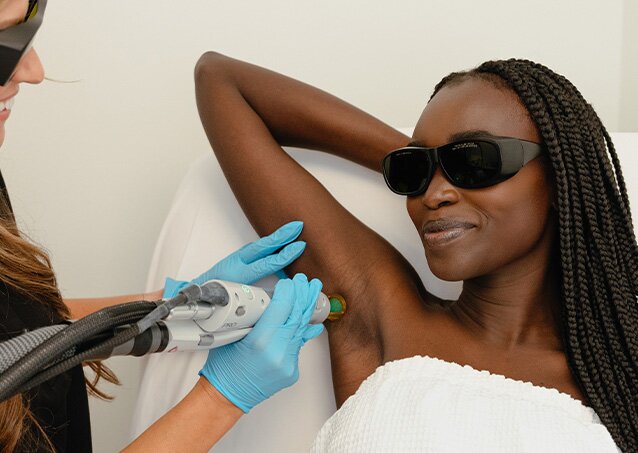
Milan uses the FDA-cleared Candela GentleMax Pro at every location, a dual-wavelength device combining the Alexandrite and the Nd:YAG. Having both wavelengths available in a single device means Milan Providers select the appropriate laser for each Client's skin tone rather than working around the limitations of a single-wavelength system.
Treatment begins using the Fitzpatrick Scale as a guide. That assessment determines which wavelength is appropriate and guides the fluence, pulse duration, and spot size settings your Provider uses at every session. Settings are adjusted at every appointment based on the individual Client's skin tone and treatment progress. No two sessions are assumed to be identical.
The Chiller, a separate cooling device, delivers continuous cool air throughout every treatment session, supporting both comfort and skin safety regardless of which wavelength is being used.
Every treatment at Milan is performed by a licensed Provider following Milan's exclusive medical protocol. Technology is one part of the equation. The expertise and physician-directed oversight behind every treatment is the other.
For more on laser hair removal across skin tones, visit our page about laser hair removal for dark skin.
Read Next: IPL Vs Laser Hair Removal: A Comparison

Milan uses the FDA-cleared Candela GentleMax Pro at every location, a dual-wavelength device combining the Alexandrite and the Nd:YAG.”
Why Milan Laser Is The Best Option
Start Your Journey Today
Discover the game-changing benefits of laser hair removal for yourself with a free consultation. This conversation is an opportunity to discuss goals, concerns, and expectations to determine a personalized treatment plan. Visit MilanLaser.com or any of our clinics across the country and join the hair-free movement today!
Frequently Asked Questions
There is no single best laser for all Clients. The right laser depends on skin tone. The Alexandrite is highly effective for lighter skin tones with dark hair. The Nd:YAG is the clinically appropriate choice for medium to dark skin tones. A dual-wavelength system that includes both, like Milan Laser’s Candela GentleMax Pro, is the most versatile option available, covering all Fitzpatrick Skin Types I through VI safely and effectively with a single device.
Both can be effective within their appropriate skin tone ranges. The Alexandrite is generally considered highly precise for lighter skin tones with dark hair. The diode covers a moderately broader range, Fitzpatrick Types II through IV, but neither offers the full-spectrum coverage of a dual-wavelength Alexandrite and Nd:YAG system. For Clients with darker skin tones, neither the diode nor the Alexandrite is the appropriate primary option; the Nd:YAG is the clinically recommended choice.
The appropriate laser for Brazilian treatment depends on the Client's skin tone, not the treatment area. At Milan, the Fitzpatrick Scale assessment determines whether the Alexandrite or Nd:YAG is used for each Client's Brazilian treatment, the same way it does for every other area. Every Milan location uses the Candela GentleMax Pro, which includes both wavelengths, ensuring the right laser is available for every Client regardless of skin tone.
Laser hair removal uses a single, focused wavelength of light that can be precisely matched to a Client's skin tone and hair color. IPL uses broad-spectrum light across multiple wavelengths, which reduces its precision and limits its ability to target the hair follicle specifically. Laser produces more effective permanent hair reduction and is significantly safer for darker skin tones than IPL. The two technologies are not equivalent, and IPL should not be considered a substitute for professional laser hair removal.
